If there were an action figure of Dr. Michael Greger, there would be one in my kitchen. I discovered Dr. Greger’s by watching his lecture on How Not to Die and reading the book afterwards, but it was his website nutritionfacts.org with over 2000 health topics that elevated him to superhero status in my household.
When your hungry to discover how to be your healthiest, you have to wade through a swamp of books based on anecdotes, active imaginations, and a lack of fundamental science. There are books written with the best intentions, books written with the goal of selling supplements, and books with the goal of selling. As someone who wants to be of sound mind to optimize what happens in the practice room and someone who wants to fuel my body for marathon training, the discovery of Dr. Greger’s tireless work reviewing the vast scientific literature (How Not to Die had about 2000 citations, How Not to Diet, 5000, and How Not to Age came in with more than 13,000!) to uncover and relay the science as clearly and concisely as possible was exactly why I had traversed that swamp for years.
Held in high esteem by pioneers and luminaries in the lifestyle medicine world such as Dr. Dean Ornish, Dr. Caldwell Esselstyn, T. Colin Campbell, Walter Willet, Dr. John McDougall, Dr. Greger’s How Not to Die, and his subsequent books How Not to Diet and his latest, still open on my nightstand, How Not to Age, provide all the supporting science on the benefits of adopting a whole food plant-based diet to maximize your biology.
To learn more about the science behind a whole-food plant-based diet while supporting our website, earn a nutrition certificate from Cornell’s Center for Nutrition Studies. Or scan the QR code below.
Almost 700,000 people in the United States died from heart disease in 2020. Not counting the exceptional death toll in 2020-2021 caused by COVID-19, according to the Centers for Disease Control (CDC), heart disease remains the leading cause of death for men, women, and people of most racial and ethnic groups in the United States. Heart disease is a lifestyle-induced disease. Meaning that the choices you make on a day-to-day basis will determine whether you develop the disease or not. Diets high in saturated fat, cholesterol, sodium, refined foods, processed foods (white flour, white sugar, oil, etc.), and alcohol are the drivers of heart disease. That really translates into red meat, processed meat (sausages, prosciutto, jerky, etc.), chicken, fish, pork, eggs, cheese, milk, or any other lactation-derived product, candy, ice cream, soda, pastries, cakes, fast food, refined oil, etc., all staples of the western diet. Though smoking also increases the risk, diet is at the heart of the matter.
In 2017, almost 7% of the US population over 20 had cardiovascular disease, and close to 72 million people went to the hospital for a heart-related problem. That number represents 1 in 5 people in the US. In 2018, 30 million people in the US were diagnosed with heart disease. Every year, almost one million people in the US have a heart attack. And, alarmingly, by the age of 10, most children in this country have already begun to accumulate fatty streaks in their arteries. Ponder that and its implications for the quality of life that cardiovascular disease imparts. You may not die now from heart disease, but what will a day in your life be like with it?
With clogged arteries (atherosclerosis), delivering oxygen to your brain is taxing, moving is a chore, exercise is more difficult, living is difficult. Your body is not functioning optimally. Complications and co-morbidities arise. You’ll likely spend time in the environment of hospitals and doctor offices. The medicines and procedures prescribed to alleviate and manage the symptoms of heart disease have a myriad of side effects, which in turn require more medicines with side effects to remedy. This can complicate and exacerbate other health issues. Pills are very expensive bandages for wounds requiring stitches. In short, from the day cardiovascular disease begins to the point where it requires “management” to the point where it manifests as heart failure, heart attack, stroke, or death, there is an extended period in life where your body is not functioning optimally, where you will not feel your best, and where your life is negatively impacted until the end point. When you are diagnosed, this is the point at which your pharmaceutical slavery is likely to begin. And doctors are ready with an arsenal of medications and procedures to prescribe, from statins to blood thinners, beta-blockers, ACE inhibitors, and stents, all doing very little to solve the underlying cause of the disease.
The period from management to manifestation is where public policy (USDA/FDA) and aggressive marketing and lobbying efforts from Big Ag and Big Pharma keep you in the gray, keeping you “managed” in a state of slightly slower rate of physical decline with a metaphorical IV to your bank account. Public policy continues to tiptoe around the influence of Big Ag and Big Pharma, shackling those suffering from chronic lifestyle-induced conditions to permanent pharmaceutical enslavement—an existence where you will be required to purchase and ingest medications for the rest of your life to relieve symptoms without resolving the underlying cause of your illness. With the cost of caring for heart disease and its related conditions in the hundreds of billions of dollars, from a financial perspective, it is hard to see the status quo changing.
The medical system has aligned with the interests of Big Pharma and Big Ag to grant them a place in deciding your fate: not knowing how you ended up with heart disease, confused and misinformed about any action you can take to both alleviate and cure your disease, and now dependent on your doctor, who likely has received no guidance on preventative nutrition and drugs for the rest of your life.
This brings us to two studies every person (cardiologist and primary care physician included) should read: Dr. Caldwell Esselstyn’s study on preventative care for heart disease and Dr. Dean Ornish’s Lifestyle Intervention Trial. They both show that in interventional randomized controlled trials, a low-fat (around 10% or less of total kcal) whole-food plant-based diet (a diet rich in fruits, vegetables, legumes, and whole grains) halts and reverses the course of cardiovascular disease. A whole-food plant-based diet also quickly frees you from pharmaceutical slavery and the suffering that comes with it. With little cost and research, it is easy to implement.
Though modern medicine can miraculously remove a tumor, fuse a disk, or set a bone, it would be unusual and yet so simple and effective to get a prescription for preventative nutrition and the proper support to implement it. This could cost very little and could, miraculously, yield a cure. No prescription pad is needed. What if there were a financial incentive to cure instead of treat the patient?
The question, “What is the risk of me getting heart disease or what is my risk of death from heart disease?” remains an abstract, distant, and difficult one to answer until you are diagnosed. Even if you can connect the dots between diet and disease, nobody does the math in their heads. Cardiovascular disease doesn’t just appear; it develops. If your diet looks like the western diet or you habitually consume foods rich in saturated fat and cholesterol (animals), you are likely developing cardiovascular disease. You shouldn’t wait for a heart attack or stroke to inform you or for your primary care doctor to effectively guide you out of the gray.
As evidence rolls in for the health benefits of adopting a whole food plant-based diet (fruits, vegetables, whole grains, legumes, nuts and seeds), the case for dropping animal products (meat, poultry, fish, dairy, and eggs) from our diets becomes compelling. Science continues to tease out the numerous mechanisms as to why the consumption of animal products is unhealthful and disease-promoting. Whether it is from saturated fat, cholesterol, TMAO, heme iron, nitrosamines, hormonal contamination, bacterial contamination, or the way each of these factors interact as a whole with our biology, the public gets mixed information due to roadblocks set up by aggressive marketing, lobbying campaigns, industry funded “science”, and, in some cases, the FDA, much in the way the tobacco industries attempted to cloud the relationship between smoking and lung cancer decades ago. Now, smoking has taken second place to poor diet in the leading cause of disease. Here are some facts about meat consumption to consider before your next meal.
The International Agency for Research on Cancer (IARC) lists the consumption of red and processed meats as carcinogenic.
Red meat contains many harmful compounds in addition to saturated fat that include arachidonic acid (highly inflammatory omega 6 fatty acid), methionine (promotes cancer growth), trans-fatty acids (aka “trans-fats”), endogenous hormones like IGF-1 (promotes tumor growth), exogenous hormonal growth promoters, antibiotics, man-made contaminants (fertilizers, pcbs, pesticides), and formaldehyde, among others.
Red meat contains bovine pathogens such as E. Coli and bovine spongiform encephalopathy which can lead to serious and life-threatening bacterial and viral infections.
Steroid hormones in meat and dairy products are complicit in the risk factors for various cancers in humans.
The digestion of meat raises Trimethylamine N-Oxide (TMAO) levels in blood dramatically. High TMAO blood levels are associated with cardiovascular disease, obesity, Alzheimer’s, and cancer. It is also associated with a dysfunctional microbiota.
Controlled trials by Dr. Dean Ornish at the Preventative Medicine Research Institute led to an inverse relationship between health outcomes and the consumption of animal products (red meat, poultry, fish, eggs, and dairy).
Reversal of coronary heart disease was achieved by eliminating meat, dairy, fish, and oil from patients’ diets during a clinical trial at the Cleveland Clinic by Dr. Caldwell Esselstyn.
In metabolic ward studies, interventional studies, and randomized clinical trials, an increase in saturated fat from dietary sources (meat, dairy, eggs) led to an increase in LDL cholesterol. High LDL levels are a primary indicator of coronary heart disease.
There is a strong correlation between diets high in dietary cholesterol (meat, eggs, dairy) and elevated risks of stomach, colon, rectum, pancreas, lung, breast, testicular, kidney, and bladder cancers.
The water footprint of producing red meat is devastating our environment. It takes approximately 1800 gallons of water to produce 1 pound of beef (roughly 30 gallons/1 g of protein) whereas it takes approximately 500 gallons of water to produce 1 pound of chickpeas (roughly 5 gallons/1g of protein). A pound of potatoes only takes 34 gallons.
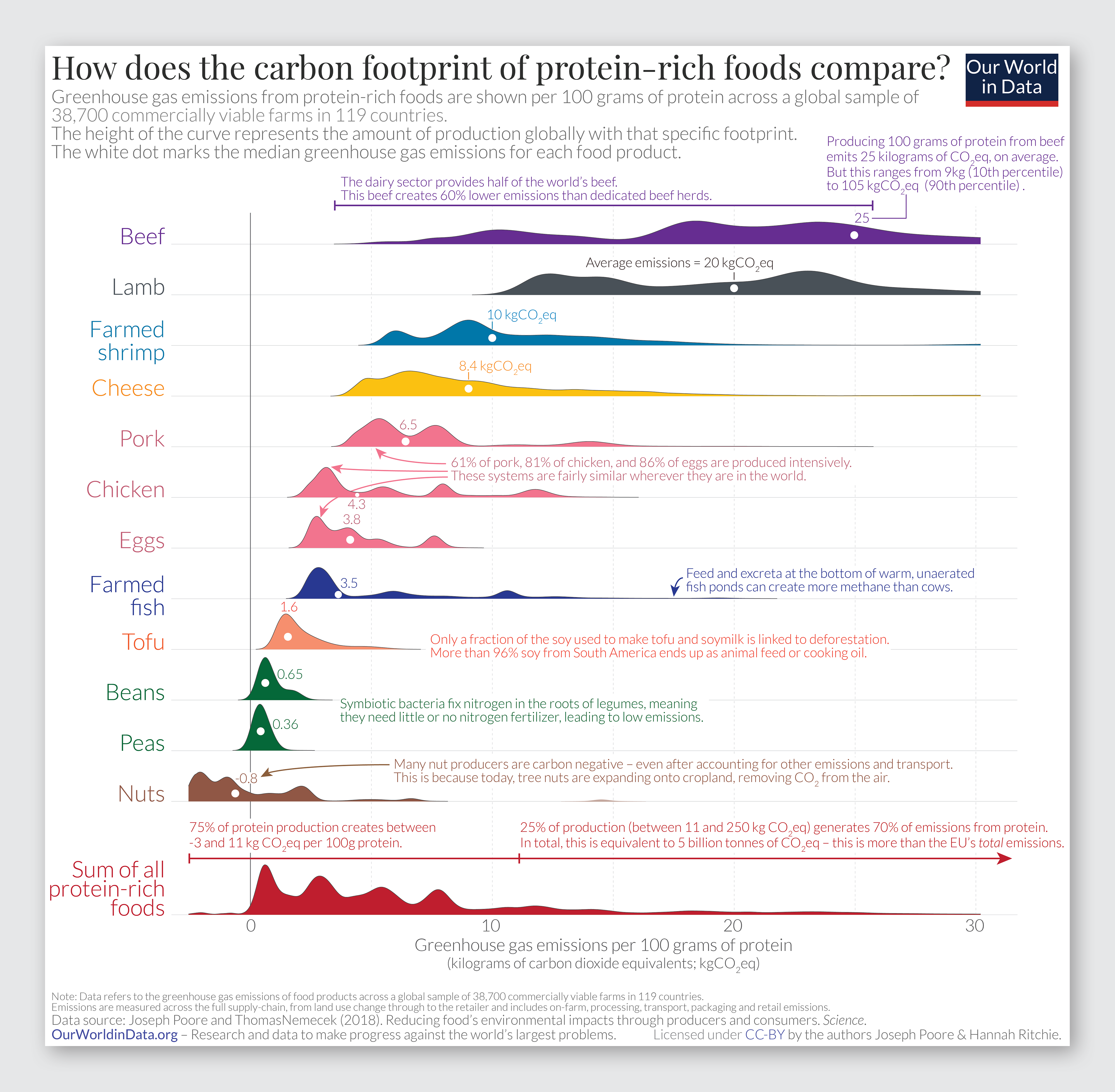
The carbon footprint of beef is 25x more than that of beans and peas combined.
Methane, a greenhouse gas and powerful driver of climate change, emissions from cattle has far more impact on global warming than previously thought.





 Rabbit Hole Runner